
PLACE: AUSTRALIA

.svg/2000px-Flag_of_Australia_(converted).svg.png) (Image from travel.nationalgeographic.com) (2nd picture from en.wikepedia.com)
(Image from travel.nationalgeographic.com) (2nd picture from en.wikepedia.com)Where is Australia?:
- Australia is a country/continent at the south of the equator in the region of Oceania.
- Countries surrounding Australia are New Zealand to the South East, Vanatu and the Solomon Islands to the North East and Papua New Guinea, Indonesia and East Timor to the North.
- Australia is made up of 8 regions; Multi-State/Territorial, Western Australia, Northern Territory, South Australia, Queensland, New South Wales, Victoria and Tasmania.
What is Australia?:
- Australia is a country and a continent as it is so big.
- Australia is about 7,692,024 km2 (2,969,907 sq mi).
- It is an MEDC (More Economically Developed Country).
- Many people like to go on holiday there because of the heat and wildlife there.
- Their currency is in Australian Dollars, which comes in $5, $10, $20, $50 and $100 notes and coins come in 5, 10, 20 and 50 cents and one and two dollar denominations.
- One of the driest continents is Australia and experiences mostly a temperate climate through out the year. The north is usually warmer most of time, whilst the south has cooler winters.
- Australia has their Summers from December to February, Autumn (Fall) from March to May, Winter from June to August and Spring from September to November. The seasons are not like the seasons in the Northern Hemisphere as they are on the other side of the Equator on the Southern Hemisphere.
- On average, a third of Australia which is desert gets less than 10 inches of rainfall a year where as the rest of the country gets less than 20 inches.
- Snow only tends to fall the Australian Alps but rarely in the rest of Australia.
- In the summer, temperature gets to roughly 28°Celsius (82°Fahrenheit) but can get above 30°C (86°F). It usually gets to 14°C in the winter.
- The hottest recorded temperature was 50.7°C (123.3°F) whilst the coldest recorded was -23°C (-9.4°F)
- The majority of people who live in Australia all came from the UK and most of them speak English. However, before the British took over the land, Aboriginal people lived there, who were the first to have lived in Australia. Aborigines still live there but most of them were killed by the people who took over the land.
- People have lived in Australia for about 40,000 to 60,000 years.
- An estimated amount of different plant species are 27,700 species, including Cycad Palms, Waratah, Kangaroo Paws, Banksia and many more.
- There are many different animals in Australia, with more than 378 species of mammal, 828 species of bird, 4000 species of fish, 300 species of lizards, 140 species of snake, two species of crocodile and around 50 types of marine mammal.
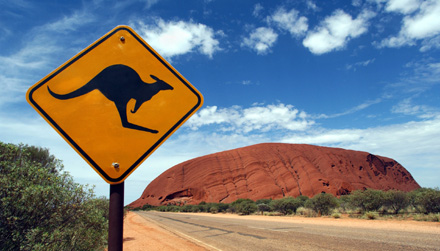 (Image from fodors.com)
ANIMAL: BEARDED DRAGON (Pogona)


- On average, Bearded Dragons live 3-7 years in the wild, but in captivity with proper care, 10-15 years and often 20.
- They get the name, Bearded Dragon because the puffy bit on their chin looks a bit like a beard.
- Although they're known more commonly as Bearded Dragons, they are also known as Pogona, which includes 8 lizard species all looking fairly similar. There is Pogona Vitticeps (the common, central Bearded Dragon) Pogona Henrylawsoni (Rankins Dragon, a smaller Bearded Dragon), Pogona Barbata (Eastern Bearded Dragon), Pogona Nullarbor, Pogonna Mitchelli, Pogona Microlepidota, Pogona Minimar (Western Bearded Dragon) and Pogona Minor (Dwarf Bearded Dragon).
- The central Bearded Dragon (Pogona Vitticeps) can grow up to around 16-24 inches or more or less, each Dragon is different.
(My own photos of my pet Bearded Dragon, Mojo)
Basic Facts:
-
Diet:
- Bearded Dragons eat 80% bugs and 20% veg, where as when they start to grow up, they gradually change to 20% bugs and 80% veg.
- The food that they will hunt and find in the wild will be a range of different insects and plants that they can find.
- In captivity, popular staple insects that are fed are Crickets, Locusts, Phoenix Worms etc with Morio (Super) Worms, Wax Worms etc as treats. They can also get a bowl of vegetables and greens such as Spring (Collard) Greens, Mustard Greens or Watercress, with the occasional bit of fruit like Apple as an example. These are all a good source of Vitamins but some veg is high in vitamins, for example carrot, so shouldn't be fed everyday.
- There are charts which show all the best food to feed to your pet Bearded Dragon.
- You will want a calcium powder to put on your insects and some veg (unless the food is already very high in calcium) and sometimes a vitamin supplement.
- Many Bearded Dragons have the natural instinct to chase after their food but some are just plain lazy and don't hunt much in captivity.
- Bearded Dragons do not naturally know to drink water, so they absorb it in rain puddles or from the moisture from their food in the wild, they can get it from their food in captivity too, but most people give them baths once a week to keep them hydrated as they need to be hydrated.
- Bearded Dragons, coming from Australia, can be found anywhere in the country, such as in your garden, on the pavement, up trees, sitting on fences, but these aren't their natural areas.
- A Bearded Dragons favourite place to be which is their natural habitat is in a rocky terrain. They may be found in the outback or in any place with lots of soil and rock.
- Keeping Bearded Dragons in captivity can take away any natural things from a Bearded Dragon, but having Slate Tiles in their vivarium and a small area with a soil area (coco fibre and play sand mix - water to help mix it) and this will be good as it helps mimic their natural environment in a way.
- They have spikes going round on their body, head and beard to help warn off predators, however, these spikes are actually soft.
- Feeling threatened or scared, a Bearded Dragon can puff out it's beard and turn it black whilst hissing to make them seem all big and scary. A male Bearded Dragon may also turn their beard black whilst bobbing their head if they are trying to be dominant or see a female. Open their mouth could also be yawning and puffing out their beard can be them just stretching it out too.
- When feeling a bit too hot, Bearded Dragons open their mouths to cool down.
- Bearded Dragons have sticky saliva and their light tip of their tongue is gooey to get their prey.
- Because of their small teeth, Bearded Dragons have strong gums and jaws to crush their prey.
- They can go darker to absorb the heat if feeling cold then go lighter if they want to absorb less heat.
- Long nails for digging to burrow for escaping heat.
- Scales and padded feet that protect them from the heat.
- Strong legs for climbing to get closer to the light and running.
- Their colour allows them to camouflage into their surroundings.
- Bearded Dragons will need to be in wooden vivariums (glass ones let out lots of heat as well as letting in unnecessary heat) with glass sliding doors. The minimum size which will last them their whole life is 4 foot by 2 foot, however, many Dragons enjoy running so 5 foot by 2 foots can often be a great size. Some people do a 3 foot by 2 foot until they are a year old and upgrade them.
- Baby Bearded Dragons will need to eat lots of bugs for growing, with 2 - 3 feedings a day eating as much as they can in 10 minutes. Sub Adults (Ages 8 months to 2 years old) have one feeding a day then 2 + years have 1 feeding every other day and as they get older it starts to get to 3 times a week. Bearded Dragons should have a bowl of vegetables on offer through out the day. Feeding should be done giving at least an hour between lights going on and off.
- They should have a 100 Watt heat lamp on the hot side of the vivarium (for a 4ftx2ft or 5ftx2ft - 80w for a 3ftx2ft). Their basking spot should be roughly 40 degrees C (105 - 115 degrees F) with the cool side at 28 degrees C.
- They need a UVB strip light going along the vivarium. This is their sunlight, without this they can get Metabolic Bone Disease. All lights should be on 12 hours a day.
- In the vivarium should be a basking log to get closer to the light (the closest they can get to the light on it at 40 degrees C), a big rock or a couple of stones for a natural look. They may also like a little place to shelter in. Substrate can be tiles, reptile carpet, fake grass, maybe with a small section of coco fibre and play sand mix. Some people use sand for the whole substrate, however, Bearded Dragons may swallow it when taking up food and can get constipated, which is often fatal.
- Bearded Dragons are very friendly, so once they are tamed, they love to be handled and love space to run around.
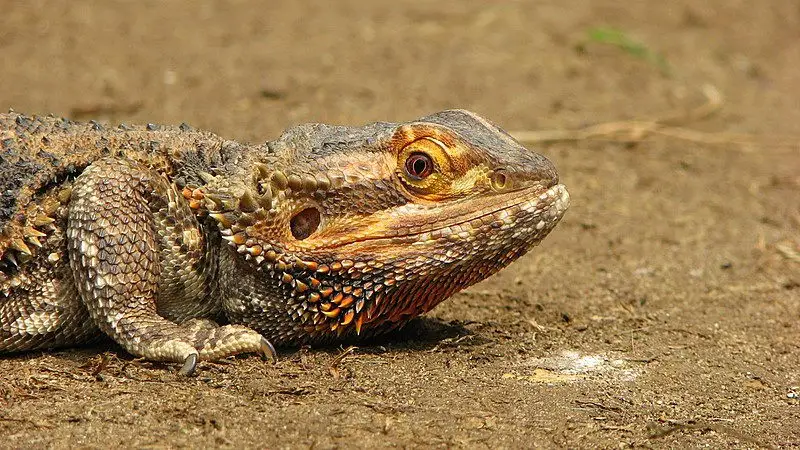 (Image from protatodiet.atspace.co.uk)


