
 (Image from livescience.com)
What is it?:
- The Sahara Desert, Arabic for 'The Great Desert', is the hottest place on Earth, being the third largest desert and almost the same size as the United States or China at 9,400,000 km2 (3,629,360 sq mi).
- Most rivers and streams there are only seasonal, except for the River Nile which runs through the desert into the Mediterranean sea.
- The Sahara used to be a fertile grassland many, many years ago, but due to the Earth's Orbital Shift, it dried up and became an arid desert.
- The Sahara Desert is located in North Africa, covering Algeria, Chad, Egypt, Libya, Mali, Mauritania, Morocco, Niger, Sudan and Tunisia.
- Bordering the Sahara, is the Mediterranean Sea to the North, The Sudan and the Valley of Niger River to the South, the Red Sea to the East and the Atlantic Ocean on the West.
- The desert is divided into several sections; western Sahara, the central Hoggar (Ahaggar) Mountains, the Tibesti Mountains, the Air Mountains, an area of desert mountains and high plateaus, Ténéré desert and the Libyan desert.
What's the weather like?:
- The Sahara Desert is known to be the hottest place on Earth at 58 degrees Celsius (136.4 degrees Fahrenheit) as its hottest recorded temperature.
- The desert is very dry and arid It rains less than an inch every year in one half of the Sahara Desert, but in the other half, it gets up to 4 inches per year. This rain can come down very heavily when it happens.
- Sand Storm and Dust Devils are caused because of the north-easterly winds in the Sahara reaching hurricane level. Sand Dunes can often reach up to 590 feet tall. The wind is what causes the deserts shape and landscape as it shifts the sand around.
- Some mountain ranges in the Sahara often get snow at the top of them. The first time it ever snowed there was when a snowstorm stopped traffic in Algeria in 1979. There has also been other rare snow storms since.
Who and what lives there?:
- Not many people at all live in the Sahara Desert because of it's hot and arid climate, but most of the people who live there are called Nomads, who move from place to place. Most of them are Berbers or Arabs. Most of the people living in the Sahara are Islamic.
- There are several animals and species like antelopes, cheetahs, ostriches, foxes, camels, goats, wild dogs, gazelles, many venomous snakes and many, many more, which live in the desert and have adapted to live there. There are 70 species of mammals, 90 species of resident birds, 100 species of reptiles, and many species of arthropods.
- The types of plants in the Sahara Desert are ones that are adapted to a very hot climate that don't need a lot of water. You will often find several Cacti, Acacia, Doum Palm, Date Palm, Thyme and more.
PLACE: AUSTRALIA

.svg/2000px-Flag_of_Australia_(converted).svg.png) (Image from travel.nationalgeographic.com) (2nd picture from en.wikepedia.com)
(Image from travel.nationalgeographic.com) (2nd picture from en.wikepedia.com)Where is Australia?:
- Australia is a country/continent at the south of the equator in the region of Oceania.
- Countries surrounding Australia are New Zealand to the South East, Vanatu and the Solomon Islands to the North East and Papua New Guinea, Indonesia and East Timor to the North.
- Australia is made up of 8 regions; Multi-State/Territorial, Western Australia, Northern Territory, South Australia, Queensland, New South Wales, Victoria and Tasmania.
What is Australia?:
- Australia is a country and a continent as it is so big.
- Australia is about 7,692,024 km2 (2,969,907 sq mi).
- It is an MEDC (More Economically Developed Country).
- Many people like to go on holiday there because of the heat and wildlife there.
- Their currency is in Australian Dollars, which comes in $5, $10, $20, $50 and $100 notes and coins come in 5, 10, 20 and 50 cents and one and two dollar denominations.
- One of the driest continents is Australia and experiences mostly a temperate climate through out the year. The north is usually warmer most of time, whilst the south has cooler winters.
- Australia has their Summers from December to February, Autumn (Fall) from March to May, Winter from June to August and Spring from September to November. The seasons are not like the seasons in the Northern Hemisphere as they are on the other side of the Equator on the Southern Hemisphere.
- On average, a third of Australia which is desert gets less than 10 inches of rainfall a year where as the rest of the country gets less than 20 inches.
- Snow only tends to fall the Australian Alps but rarely in the rest of Australia.
- In the summer, temperature gets to roughly 28°Celsius (82°Fahrenheit) but can get above 30°C (86°F). It usually gets to 14°C in the winter.
- The hottest recorded temperature was 50.7°C (123.3°F) whilst the coldest recorded was -23°C (-9.4°F)
- The majority of people who live in Australia all came from the UK and most of them speak English. However, before the British took over the land, Aboriginal people lived there, who were the first to have lived in Australia. Aborigines still live there but most of them were killed by the people who took over the land.
- People have lived in Australia for about 40,000 to 60,000 years.
- An estimated amount of different plant species are 27,700 species, including Cycad Palms, Waratah, Kangaroo Paws, Banksia and many more.
- There are many different animals in Australia, with more than 378 species of mammal, 828 species of bird, 4000 species of fish, 300 species of lizards, 140 species of snake, two species of crocodile and around 50 types of marine mammal.
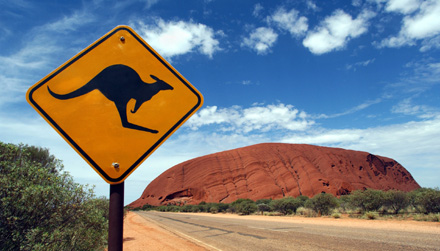 (Image from fodors.com)
No comments:
Post a Comment